Manual handling assessments: cut the lifting, not just bend your knees
What a manual handling assessment needs: avoid, assess, reduce, and the four factors to check. Practical steps to cut lifting in a small firm.
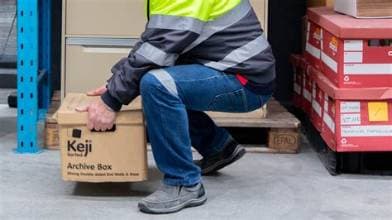
HSEQ Nova Guidance | Manual handling | 6 min read
Every small firm has a manual handling plan. It usually goes: “Two of you grab that end.”
Lifting, carrying, pushing and pulling are part of nearly every job our readers do. Steel lengths in the fab shop, bags of adhesive on site, cases of chemicals in the cleaners’ van, sacks of flour in the bakery, pallets that arrived without a pallet truck in sight.
The law doesn’t ban any of that. It asks you to think about it in a set order. This post covers what that order is, what a manual handling assessment actually needs to contain, and how to cut the lifting rather than just running another “bend your knees” session.
Key takeaways
The Manual Handling Operations Regulations 1992 set an order: avoid, then assess, then reduce.
The law sets no weight limit. HSE’s guideline figures are a screening filter, not a safe limit.
An assessment looks at four things: the task, the load, the working environment and the individual.
HSE is clear that training won’t ensure safe handling on its own. Fix the job first.
Write it down, keep it simple, and review it when the job changes.
What the law actually requires
Regulation 4 of the Manual Handling Operations Regulations 1992 puts the duty on the employer. In short:
Avoid manual handling that carries a risk of injury, so far as is reasonably practicable.
Where you can’t avoid it, make a suitable and sufficient assessment of it.
Reduce the risk of injury to the lowest level reasonably practicable.
Give people information on load weights and which side is heaviest when the weight isn’t central, where reasonably practicable.
Review the assessment if you suspect it’s no longer valid or the job has changed significantly.
Employees have a duty too. Regulation 5 says they must make proper use of the system of work you’ve put in place. So if you’ve bought a sack truck, it’s meant to leave the corner of the store.
Myth one: “The limit is 25 kilos”
There isn’t one. HSE’s guidance states plainly that the law sets no specific weight limits.
What HSE does publish is a risk filter in its leaflet Manual handling at work (INDG143). It gives guideline weights for lifting and lowering at different hand heights. The highest figures in it are 25 kg for men and 16 kg for women, and they shrink as hands move away from the body or up towards the shoulder or down towards the floor.
HSE says these are not safe limits. They’re a way to spot tasks that are probably low risk. HSE also says you need a more detailed look if lifting happens more than about once every two minutes, involves twisting, or puts hands outside the filter zones.
So “it’s under 25 kilos” is not an assessment. A 20 kg bag lifted off the van floor fifty times a morning is a very different job from one lifted once onto a bench.
The four things your assessment must look at
Schedule 1 of the regulations lists the factors. HSE groups them the same way, and many trainers shorten them to TILE.
Factor | Questions to ask | Typical example |
|---|---|---|
Task | Held away from the body? Stooping, twisting, reaching up? How far, how often, enough rest? | Lifting plate from a floor stack to a saw bed; all shift |
Load | Heavy? Bulky? Hard to grip? Contents likely to shift? | Part-full drums of cleaning chemical |
Environment | Room for good posture? Uneven or slippery floor? Poor light? Hot or cold? | Carrying materials up a muddy, sloped site access |
Individual | Does it need unusual strength or height? Any health issue or pregnancy? Training needed? | A new start or someone back from a back injury |
Schedule 1 also asks whether PPE or clothing restricts movement. Rigger boots and stiff gloves count.
HSE’s guidance adds some warning signs to look for: people sweating or breathing heavily, complaints of fatigue, and reluctance to do a particular job. If everyone mysteriously goes for a break when the steel delivery arrives, that’s data.
Cut the lifting before you train the lifting
This is where most of the real gains are. HSE’s own suggestions, applied to the jobs our readers do:
Ask whether it needs moving at all. Can the supplier deliver straight to where the material is used, rather than to the yard gate?
Use a handling aid. Sack trucks, pallet trucks, trolleys, vacuum lifters, hoists and the forklift that’s already on site.
Change the load. Smaller bags, smaller containers, loads split into lighter ones. Ask suppliers for handles or smaller packs.
Change the layout. Store heavy stock between knee and shoulder height, not on the floor or the top shelf. Shorten carrying distances and cut out the twist.
Fix the environment. Clear routes, better flooring, better lighting, enough space to stand properly.
Fix the pace. Avoid tight deadlines that make people rush, and rotate tasks so the same muscles get a rest.
None of these needs a new system. A racking reshuffle and a phone call to a supplier can remove more risk than a year of refresher training.
Where training fits
Training still matters. HSE’s guidance says it should match the work being done, explain how injuries happen, show people how to use the aids you provide, and include practical sessions where poor habits can be spotted and corrected.
But HSE also says training won’t ensure safe manual handling on its own. If the job is badly designed, a certificate in the van doesn’t fix it.
How to write it down
HSE says to record the significant hazards, who could be harmed and the controls in place, and to keep it simple. Firms with fewer than five employees don’t have to write it down, though it’s still useful.
A practical approach for a small firm:
List the handling jobs. Walk around with the people who do them. They’ll tell you which jobs everyone avoids.
Screen them. Use HSE’s risk filter to set aside the clearly low-risk ones.
Assess the rest properly. HSE’s free tools help here: MAC for lifting, carrying and team handling, V-MAC where load weights vary, and RAPP for pushing and pulling.
Record the controls, not an essay. What you’ve changed, what aids are provided, who’s been shown how.
Review it when the job, the kit, the stock or the people change.
Quick self-check
Do we have a list of our regular manual handling jobs?
Have we asked whether each one can be avoided or mechanised?
Do people know roughly what the heavy loads weigh?
Are handling aids provided, working and actually used?
Is heavy stock stored at a sensible height?
Has the assessment been looked at since the last change in work or kit?
Frequently asked questions
What is the maximum weight a person can lift at work in the UK?
There is no legal maximum. HSE publishes guideline figures to help screen tasks, but it says they are not safe limits. The risk depends on posture, frequency, distance, the load and the person.
Do I need a separate manual handling risk assessment?
Where hazardous handling can’t be avoided, the regulations require a suitable and sufficient assessment of it. It can sit within your wider risk assessments, as long as it covers the task, load, environment and individual.
Is a manual handling training course enough?
No. HSE says training alone won’t ensure safe handling. Avoiding and reducing the handling comes first, with training supporting the system you’ve put in place.
How often should a manual handling assessment be reviewed?
The regulations say whenever there’s reason to think it’s no longer valid, or there’s been a significant change. New equipment, new products, a new site layout or a new starter are all good prompts.
The bottom line
Avoid it, assess what’s left, reduce the risk. The law has no magic number, and a training certificate isn’t a control. The biggest wins usually come from asking why the load is being lifted at all, then changing the job so fewer lifts are needed.
HSEQ Nova keeps your risk assessments, actions, training records and evidence in one place, so your manual handling assessment isn’t a sheet of paper behind the kettle. It doesn’t replace your competent person, and as the employer, you keep the legal duty. If you’d like a hand working through your handling jobs, get in touch.
HSEQ Nova | 07498 312139 | callum@hseqnova.co.uk
Sources and further reading
Related articles
Asbestos rule change 2026: what it means for small trade firms
HSE has tightened the asbestos rules. Most of it is not aimed at small trades, but your duties before drilling are. Here is what to check today.

Toolbox talks that count as evidence: what to do and what to keep
Toolbox talks that count as evidence? A signed sheet alone won’t do it. How to run a short talk that works and what records are worth keeping.

Working at height for roofers and scaffolders: the hierarchy, not just harnesses
Roofers and scaffolders: what the Work at Height Regulations ask for, why the harness comes last, and the records worth keeping.