Your health and safety policy in plain English: statement, responsibilities and arrangements
What goes in a small firm’s written H&S policy: the statement of intent, responsibilities and arrangements.
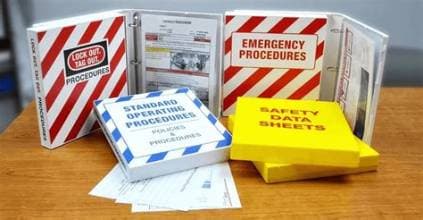
HSEQ Nova Guidance | Health and safety policy | 6 min read
Most small firms do have a health and safety policy. It’s usually a document someone downloaded years ago, with a different company’s name still in the footer on page three.
That’s not a crime against paperwork. But when a main contractor, insurer or auditor asks for your policy, they’re not checking you own one. They’re checking it describes the firm you actually run.
The good news: the law asks for something short and practical. Here’s what it is.
Key takeaways
Every business must have a policy for managing health and safety. With five or more employees, it must be written down.
A policy has three parts: a statement of intent, responsibilities (who does what) and arrangements (how you actually do it).
You must share the policy, and any changes to it, with your employees.
It should be revised as often as appropriate, so a policy that still names last decade’s foreman needs a look.
A template is a starting point, not the finished article.
What the law requires
Section 2(3) of the Health and Safety at Work etc. Act 1974 requires employers to prepare, and revise as often as appropriate, a written statement of their general policy on health and safety, along with the organisation and arrangements for carrying it out. They must also bring it, and any revision, to the notice of all employees.
There’s one exception. Under the Employers’ Health and Safety Policy Statements (Exception) Regulations 1975, an employer with fewer than five employees doesn’t have to do this. HSE’s guidance is clear that you still need a policy for managing health and safety; you just don’t have to write it down. HSE also says it’s useful to do so anyway.
Separately, regulation 5 of the Management of Health and Safety at Work Regulations 1999 says employers must have arrangements for planning, organising, controlling, monitoring and reviewing their preventive and protective measures, suited to the size and nature of the business. With five or more employees, those arrangements must be recorded.
So for a 5–50 person firm, writing it down isn’t optional.
The three parts, in plain English
HSE’s guidance splits the policy into three areas.
Part | What it says | Plain English test |
|---|---|---|
Statement of intent | Your general policy, your commitment to managing health and safety and your aims | Would you be happy reading it out to the squad? |
Responsibilities | The names, positions and roles of people with specific health and safety duties | If something goes wrong on Tuesday, does everyone know who deals with it? |
Arrangements | The practical arrangements you have in place to achieve your aims | Does it describe what really happens, not what a template thinks happens? |
Part 1: Statement of intent
This is the short bit at the front. HSE says the employer or most senior person in the company should sign it and review it regularly.
Keep it to a few lines. Your commitment, your aims, a signature and a date. If it reads like a mission statement from a bank, it’s too long.
Part 2: Responsibilities
This is where most downloaded policies fall over. HSE says to list the names, positions and roles of the people with specific health and safety duties.
Not “the Health and Safety Director” if you don’t have one. Real people. For a typical small firm, that might be:
The owner or director: overall responsibility, signs the policy, makes sure resources are there.
Supervisors or chargehands: day-to-day checks on site or in the workshop.
The person who keeps the records: training, inspections, accident book.
Employees: following the arrangements and reporting problems.
Your competent help: whoever gives you health and safety advice, in-house or external.
Part 3: Arrangements
This is the “how”. HSE gives examples such as doing risk assessments, training employees and using safety signs or equipment. In practice, the arrangements for a small trade or engineering firm usually cover things like:
Risk assessment: who does them, and when they get reviewed.
Training: inductions, tickets and refreshers, and where the records live.
Equipment: inspection and maintenance of tools, plant and lifting gear.
Hazardous substances: how COSHH is handled.
Accidents and incidents: how they’re recorded and reported.
First aid and emergencies: who, what and where.
Consultation: how you talk to the team about health and safety.
Only include what you actually do. An arrangement that says “monthly documented inspections” is evidence for you if you do them, and evidence against you if you don’t.
What this means in practice
A policy is the one document every other health and safety record hangs off. Your risk assessments, training matrix and inspection sheets are the proof that the arrangements are real.
That’s why buyers ask for it first. A tidy policy backed by records that match it reads well. A beautiful policy with nothing behind it reads like the folder labelled “we’ll sort it after the tender”.
Update it in four steps today
Read it start to finish. Every name, every role, every arrangement. Bonus points for finding the other company’s name in the footer.
Fix the responsibilities. Replace job titles that don’t exist with real names and roles.
Strike out what you don’t do. Then either start doing it, or remove it.
Sign, date and share it. The most senior person signs. Then make sure the team actually sees it: a toolbox talk, the canteen wall or a message to everyone, and keep a note that you did.
Quick self-check
Five or more employees, and the policy is written down
Statement of intent signed and dated by the most senior person
Responsibilities list real names and roles
Arrangements match what actually happens
Employees have been told about it, and about the latest changes
There’s a review date, and it hasn’t long passed
Frequently asked questions
Do I need a written health and safety policy?
If you employ five or more people, yes. Under five, you still need a policy for managing health and safety, but you don’t have to write it down. HSE says it’s useful to, and plenty of clients will ask for it regardless.
How often should I review my health and safety policy?
The law says revise it as often as appropriate, and HSE says to review it regularly. Many firms set a fixed review date and also review it whenever something significant changes: new premises, new work, new people in key roles, or after an incident.
Can I use HSE’s template?
Yes. HSE publishes an example policy and a template to help you write your own. The template gives you the structure; the content has to describe your business.
Who should sign the policy?
HSE says the employer or most senior person in the company should sign it. That’s usually the owner or managing director.
The bottom line
A health and safety policy isn’t a long document. It’s three plain answers: what you’re committed to, who’s responsible for what, and how you actually do it. Write it for your firm, keep it current, share it with the team, and make sure your records back it up.
Need a hand?
HSEQ Nova keeps your policy, risk assessments, training records and actions in one place, so the evidence behind your arrangements is easy to find when a client asks. It doesn’t replace your competent person, and the employer keeps the legal duty. If you’d like a hand getting your policy into shape, get in touch.
HSEQ Nova | 07498 312139 | callum@hseqnova.co.uk
Sources and further reading
Related articles
Asbestos rule change 2026: what it means for small trade firms
HSE has tightened the asbestos rules. Most of it is not aimed at small trades, but your duties before drilling are. Here is what to check today.

Toolbox talks that count as evidence: what to do and what to keep
Toolbox talks that count as evidence? A signed sheet alone won’t do it. How to run a short talk that works and what records are worth keeping.

Manual handling assessments: cut the lifting, not just bend your knees
What a manual handling assessment needs: avoid, assess, reduce, and the four factors to check. Practical steps to cut lifting in a small firm.